







There is a growth or transformation objective
The company needs to change revenue, profit, margins, scale, its management model or the owner’s level of involvement in day-to-day operations.

 Business management system25 solutions
 Strategy and development5 solutionsBusiness acceleration and tracking4 solutions
 AI implementation7 solutions
 Business management systemFlagship end-to-end program
 Choose a learning programPrograms, formats and pricingSpecialized programsSeven management system areas
For business owners and management teams when growth or transformation requires coordinated change across several parts of the company. We analyze the business end to end, validate a measurable objective, build a prioritized roadmap and support execution of priority projects in monthly cycles.
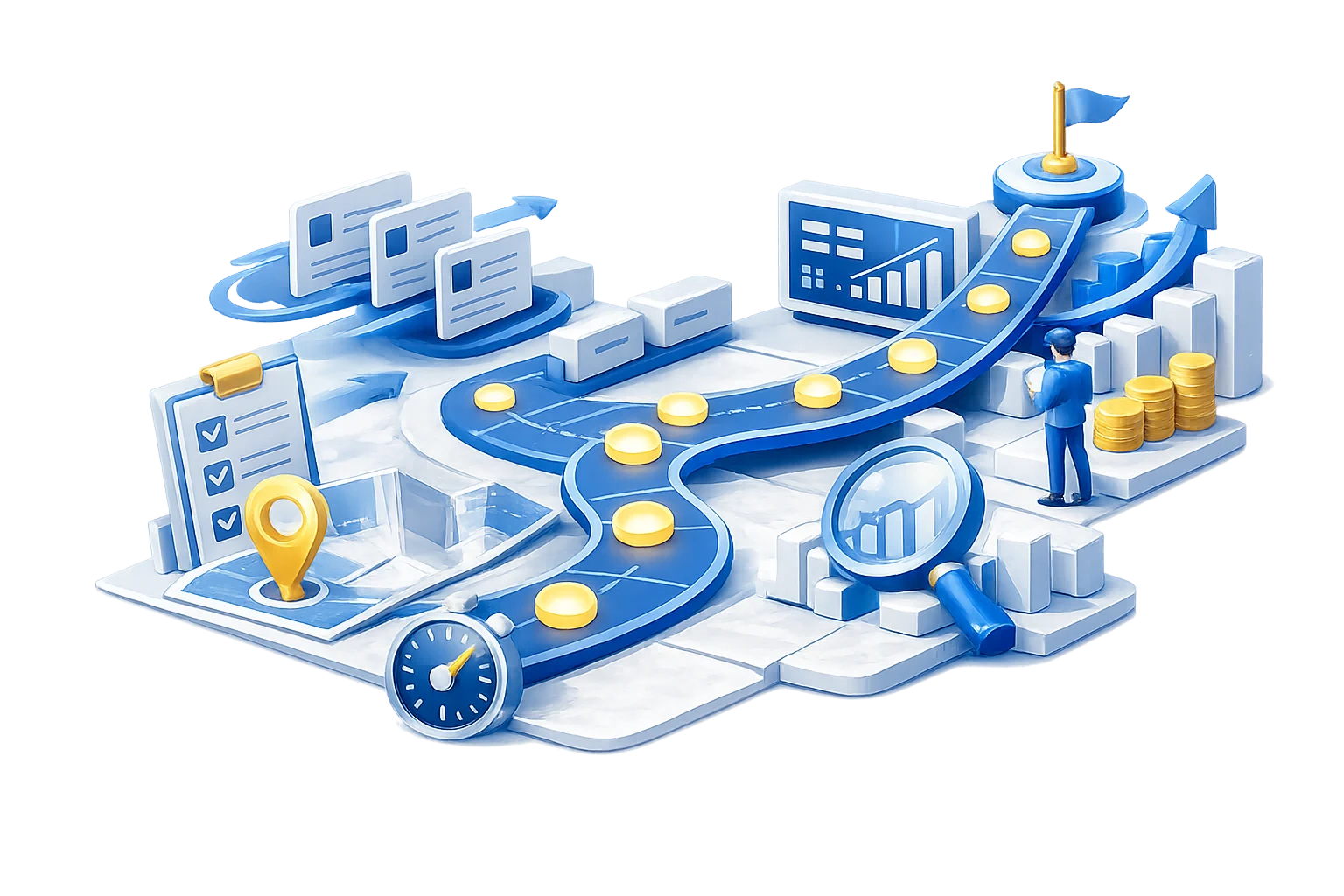
Business acceleration is appropriate when the outcome depends on several parts of the business, the sequence of changes must be coordinated, and the management team needs structured support to execute them.
The company needs to change revenue, profit, margins, scale, its management model or the owner’s level of involvement in day-to-day operations.
The outcome depends simultaneously on sales, marketing, finance, operations, logistics, processes, people or governance.
There are many tasks, but no evidence-based view of which projects will move the company toward the objective or in what order they should begin.
The team needs a clear monthly focus, weekly commitments and regular reviews of evidence, blockers and results.
The engagement does not start with a predefined package of solutions. We first test the owner’s initial objective against the actual state of the business and only then design the sequence of projects.
We define the expected business change and the qualitative and quantitative metrics that will demonstrate it.
We examine the evidence, refine the objective and prioritize the required projects in a roadmap.
We select a focused set of projects, assign accountable owners and manage execution through four weekly sprints.
The owner receives more than a list of recommendations: a clear logic for change—what the assessment revealed, which projects are required, what is being executed now and how results will be measured.
Projects outside the current focus remain in the roadmap and move into execution after the current monthly cycle is completed or reprioritized.
The initial objective has been tested against evidence and expressed as a specific qualitative and quantitative result.
We document how critical functions and processes operate and where the company loses money, information, speed or accountability.
The required projects, their sequence and their connection to the company objective are defined.
A focused set of projects is selected for immediate execution instead of launching the entire roadmap at once.
Every week, the owner can see completed commitments, blockers, decisions and next actions.
At the end of each month, the roadmap is updated using actual results and new evidence.
The scope of the assessment depends on the company’s operating model. The analyst systematically gathers evidence from every part of the business that may affect the owner’s objective.
How the company developed, which business lines and legal entities form the business, and how responsibilities are divided among owners and executives.
Products and services, sales funnels, conversion rates, acquisition channels, customer acquisition cost, average order value, team structure and tools in use.
Revenue, profit, margins, accounts receivable and payable, debt burden and the reliability of management reporting.
How products are produced or services delivered, and how operations, procurement, logistics, partnerships and supply chains are organized.
Team composition, allocation of responsibilities, recruitment, training, onboarding, employee turnover and availability of the required capabilities.
Each critical process is mapped by input, activity, output and one accountable owner. We identify where operating rules, data or accountability are missing.
The objective is examined twice: first as the owner’s initial request and then, after the assessment, as a validated and measurable outcome. Only after that are the roadmap and first-month projects defined.
We document the change the owner expects and the qualitative and quantitative indicators that will be used to measure it.
We analyze the company’s history, sales, marketing, finance, delivery model, operations, logistics, suppliers, team, operating procedures and critical processes.
We compare the initial objective with actual metrics, available resources and identified constraints. When necessary, we adjust the objective or the proposed route to achieve it.
We define the required projects across the relevant business areas and sequence them: what comes first, what follows and who participates from the company.
From the full roadmap, we select the projects for the current month. For each project, we define the deliverable, success metric, deadline and one accountable owner.
Monthly commitments are divided into four weekly sprints. At each review, the analyst checks evidence, progress and blockers; subject-matter experts join when needed. Between meetings, the team can work with an AI assistant.
We assess the actual change achieved, close or adjust active projects and select the next priority from the roadmap.
Only projects with four mandatory parameters defined in advance enter the weekly execution cycle.
The concrete result that must exist when the project is complete.
The metric that will show whether implementation produced the intended change.
The date by which the agreed result must be delivered.
The person inside the company who is accountable for the result, even when a working group performs the work.
Each week, the team reviews completed commitments, evidence, blockers and the decisions required for the next step.
Business acceleration does not mean implementing every Business Evolution solution at once. The roadmap includes only the changes required to achieve the validated objective; their scope and sequence are determined by the company’s actual situation.
View all solutionsStrategic choices, growth vectors, products, markets, business model, financial logic and the sequence of initiatives.
Acquisition channels, sales funnels, conversion rates, customer-base management, sales-team performance, CRM and commercial metrics.
Revenue, profit, margins, receivables and payables, management accounting, operations, service delivery, procurement, logistics and suppliers.
Roles and accountability, critical processes, operating procedures, task management, metrics, recruitment, onboarding, training, AI assistants and automation.
Responsibility for change remains inside the company. Business Evolution helps analyze the situation, structure the roadmap, bring in the required expertise and maintain a disciplined weekly execution cadence.
Defines the initial objective, participates in its validation, makes key decisions and removes constraints that the management team cannot resolve on its own.
Provides data for its areas, takes accountability for projects and completes the commitments of each weekly sprint.
Conducts the business assessment, develops the roadmap, leads weekly execution reviews and keeps active projects aligned with the objective.
Subject-matter experts join specific functional workstreams. The AI assistant supports the team between meetings; questions requiring a management decision or specialist judgment are escalated to the analyst or relevant expert.
Weekly review of progress, blockers and next actions
Business acceleration combines diagnostic, execution-support and system-change tools around the objective of a company or portfolio.
Regular support for executing business objectives and projects.
View solution →Designed for portfolios, clusters and groups of companies.
View solution →Identification of constraints, priorities and the scope of the first stage.
View solution →Changes in roles, processes, metrics and management cadence.
View solution →Principles of business assessments, objective decomposition and implementation support.
View solution →The Business Evolution team developed the program methodology, organized tailored work with participating companies, provided business tracking and coordinated subject-matter experts.
View the case study →For an initial conversation, describe the expected outcome, the current situation and the management team involved. We can then determine whether the company needs full business acceleration, a focused project or business tracking.