













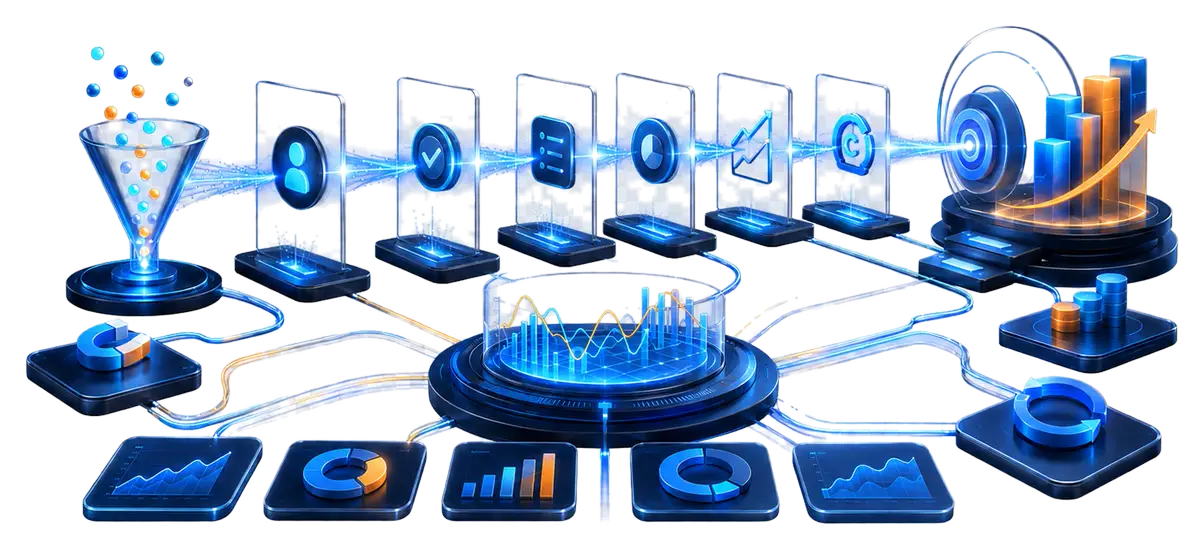
Sales system
with a managed pipeline

We design consistent qualification and deal-management rules, CRM data, revenue forecasting and the head of sales operating model—so the company can see the true state of the pipeline and identify plan-delivery risks in advance.

For short-cycle, high-volume, repeat, partner and complex sales—the depth of the system is adapted to the business model. We first establish the process and decision data, then implement CRM and automation.
Sales system: pipeline, forecast and department management
SALES MODEL

Select the scenario closest to your business

A sales system should not manage infrequent high-value deals in the same way as a large flow of quick purchases. Select a tab to see the characteristic losses, required rules and metrics. If the company has several models, the project combines the relevant sales-management models.

SCENARIO 01

Few high-value deals and a high cost of error

Each deal materially affects the plan, while the customer’s decision may take weeks or months. What matters here is qualification quality, risk management and a clear forecast for every opportunity.

PAIN POINTS

Where revenue is lost

  • Deals remain at one stage for months and are repeatedly pushed into the next period.
  • Status depends on the salesperson’s confidence rather than confirmed facts.
  • Decision participants, selection criteria, budget and constraints are not documented.
  • The next step has no date, expected result or customer-side owner.
SOLUTION

What we configure

  • Qualification and stop-work criteria for weak opportunities.
  • A map of participants, the selection process and decision risks.
  • A deal plan with milestones and a confirmed next step.
  • Forecast categories and recurring management reviews of key deals.

What management controls

Deal and stage ageWhere the decision has stalled and how much time remains before the critical date.
Confirmed next stepWhether there is a specific customer action, deadline and expected result.
Forecast substantiationWhich facts support the amount, probability and revenue period.
CORE PRINCIPLE

A pipeline stage changes only after a confirmed customer event

The pipeline must reflect the customer’s actual progress, not the number of actions performed by a salesperson. In short-cycle sales, such an event may be a completed contact, selection of terms or payment; in complex sales, a confirmed need, identified decision participants and an agreed next step.

Review the current pipeline →
1

Contact or interest has been confirmed

The salesperson has not merely attempted contact: the customer responded, submitted a valid inquiry, confirmed interest or completed the target action.

2

The need and suitable scenario have been identified

It is clear what the customer needs, which product or format is appropriate and whether there is a basis for continuing the work.

3

The customer has taken the next step

This may be a booking, selection of terms, payment, repeat order, agreement to a meeting or a decision to continue a complex deal.

4

The result is recorded according to a consistent rule

CRM contains the status, amount or potential, deadline, reason for loss and next action. Identical events receive the same status.

OUR APPROACH

Management rules first, then CRM and automation

Tools strengthen a clear process. If the deal logic has not been defined, automation merely collects non-comparable data faster.

CRM will not fix an unclear pipelineWe first define stages, criteria, mandatory data and rules for handling stalled inquiries and deals.
Probability cannot be based on intuitionWe use historical stage conversion and confirmed risks, while recognizing that a forecast remains an estimate rather than a guarantee.
Pipeline size is not the same as pipeline qualityQualified inquiries, active deals and timely repeat contacts matter more than the nominal number of CRM records.
SYSTEM ARCHITECTURE

Four management domains adapted to your sales model

Short-cycle, repeat and complex sales require different levels of detail, but the management logic is consistent: define the target flow, describe the customer journey, capture the necessary data and configure management decisions.

Segments, channels and sales scenarios

We define who we sell to, what we sell, where the customer comes from, and how the first purchase, repeat sale, partner channel, tender or project deal differ.

  • target segments and products
  • inquiry sources and handover rules
  • priorities, constraints and rejection criteria

Customer journey and operating standards

We describe the journey from inquiry to payment and the next purchase. For each step, we define the expected result, deadline, owner and basis for moving forward.

  • response speed and contact rules
  • stages, criteria and next step
  • reasons for rejection, re-engagement, and closure

CRM, analytics and forecasting

For high-volume sales, we track volume, speed and conversion; for repeat sales, customer activity; for complex sales, amount, timing, participants and risks.

  • minimum required data
  • reports and variance signals
  • forecasting model aligned with the sales cycle

Team management and system improvement

We separate day-to-day performance management, planning, quality reviews, key-deal management and salesperson development. Findings are fed back into marketing, product and service.

  • daily and weekly cadence
  • manager and team accountability
  • analysis of conversion, reasons for losses, and re-engagement
WHAT WE DO IN THE PROJECT

From sales assessment to independent management by the Head of Sales

We do not hand over a universal methodology as a presentation. The rules are designed around the actual flow of inquiries, deals and customers, tested on real data and embedded in the team’s daily work.

Assess the current system

We analyze segments, products, channels, inquiries, deals, the customer base, CRM, reporting, forecasting, team performance and causes of loss.

Deliverables:gap map, baseline metrics and project priorities.

Design the sales model

We agree the sales scenarios, customer journey, stages, response standards, qualification and rules for repeat and key deals.

Deliverables:a common process logic for management and the team.

Configure data and forecasting

We define mandatory fields, reference data, signals, reports, metrics and the forecasting model, accounting for volume, conversion, amount and timing.

Deliverables:CRM requirements and comparable decision data.

Test the rules on the actual flow

We apply the new standards to current inquiries, deals and customers, remove ambiguities and verify that the rules do not create unnecessary bureaucracy.

Deliverables:a validated version of the process, not a theoretical diagram.

Launch the management cadence

We separate operational signals, tracking of conversion and response speed, forecasting, key-deal work and salesperson development.

Deliverables:clear control and decision formats for each level.

Train and hand over the system

The head of sales practices the new rules with the team and becomes the owner of the process, metrics and future improvements.

Deliverables:independent management without ongoing consultant support.
WHAT THE COMPANY RECEIVES

An operating toolkit for the team, management and CRM

The composition depends on the sales model. For a short cycle, the toolkit will be compact; for complex and project sales, more detailed. In both cases, the result is used in daily work rather than left as a separate presentation.

Map of sales models and scenarios

Target segments, products, channels, first- and repeat-sale routes, lead-handover rules and participant roles—where they are actually required.

Customer-work standards

Stages and criteria, response speed, next-contact rules, qualification checklists, loss reasons and a key-deal plan template.

Data, analytics and forecasting framework

CRM requirements, mandatory fields and reference data, data-quality rules, flow and deal metrics, forecasting model and variance signals.

Sales-management procedures

Formats for day-to-day performance management, pipeline and forecast reviews, salesperson management, loss analysis, repeat sales and customer handover to delivery.

Documents do not remain isolated files.

We test the rules on current inquiries, deals and customers, then embed them in CRM, team workflows and the head of sales’ accountability.

IMPLEMENTATION STAGES

How the system becomes part of daily work

Each stage ends with a defined deliverable. The next step begins only after the decisions have been tested against data and real deals.

1

Assessment

We examine the active pipeline, cycle, conversion, forecast, CRM, roles and meetings. Outcome: problem map, baseline metrics and agreed priorities.

2

Design

We define segments, buying model, stages, criteria and qualification. Outcome: agreed process model and rule set.

3

Data configuration

We create fields, reference data, reports, signals and templates. Outcome: CRM and analytics support management decisions.

4

Pilot

We test the system on active deals and train the head of sales to conduct reviews. Outcome: ambiguities are eliminated and the rules’ applicability is confirmed.

5

Launch the management cadence

We establish meetings, roles, metrics and data-driven improvements. Outcome: the manager independently runs the system and team.

OUTCOMES AND METRICS

What changes in sales management and how it is verified

Results are assessed not by the number of documents, but by whether the company processes inquiries faster, loses fewer customers, sees the true pipeline and makes decisions before a variance becomes a problem.

The flow of inquiries and deals becomes transparentThe company can see where customers come from, how quickly the team responds, where progress stops and what portion of the flow can realistically generate revenue.
Statuses become comparableIdentical events receive the same status, allowing conversion to be compared by segment, product, channel, location and salesperson.
The forecast becomes explainableIn high-volume sales it is based on volume, speed and conversion; in complex sales, on deal amount, timing, stage and risks.
Losses and delays decreaseWe measure response speed, time in stage, missed contacts and reasons for stoppage so the company can influence the result rather than merely count activity.
The manager leads the team instead of fighting firesControl ends with decisions: redistribute flow, change a priority, add resources, close a stalled deal or develop a salesperson’s skill.
Causes of losses and repeat purchases become improvementsData is fed back into marketing, product, pricing, service and team training.
SAMPLE DELIVERABLE

What a stage standard looks like—from inquiry to next action

Below is the universal logic for a stage. In short-cycle sales, the standard may take only a few lines; in complex and project sales, it is supplemented with decision participants, budget, risks and a deal plan.

View the complete set →
1

Entry criterion

The source of the customer, the product or customer need and what must be completed at this stage are clear.

2

Mandatory data

The contact result, product or scenario, amount or potential, deadline, owner and next action are recorded.

3

Exit criterion

The customer has completed the target action: confirmed interest, selected terms, booked, paid, placed a repeat order or agreed the next step.

4

Management review

The response-time standard, maximum time in stage and action required when there is no response or progress are defined.

BEFORE THE PROJECT STARTS

Questionsabout implementation

NEXT STEP

Get a map of current pipeline problems and a prioritized change plan

During the assessment, we review the inquiry flow, deals, customer base, data quality, forecast and management practices. The result identifies where revenue is being lost and which changes will have the greatest impact.

  • We will show where inquiries, deals and repeat sales are being lost
  • We will assess data quality and whether the metrics are sufficient for forecasting
  • We will create a prioritized change plan for management and the team
Discuss a sales assessment

No CRM purchase or automation before the process rules are clear.