













Job descriptions as
a management tool for every role
We develop role profiles and detailed job descriptions that define the expected output, responsibilities, business processes, decision authority, operating standards and assessment criteria for each position.
A practical job description reduces repeated explanations, standardizes work and shortens the path from onboarding to independent performance.It becomes a shared reference for the employee, manager, HR team, trainers and quality-control function.
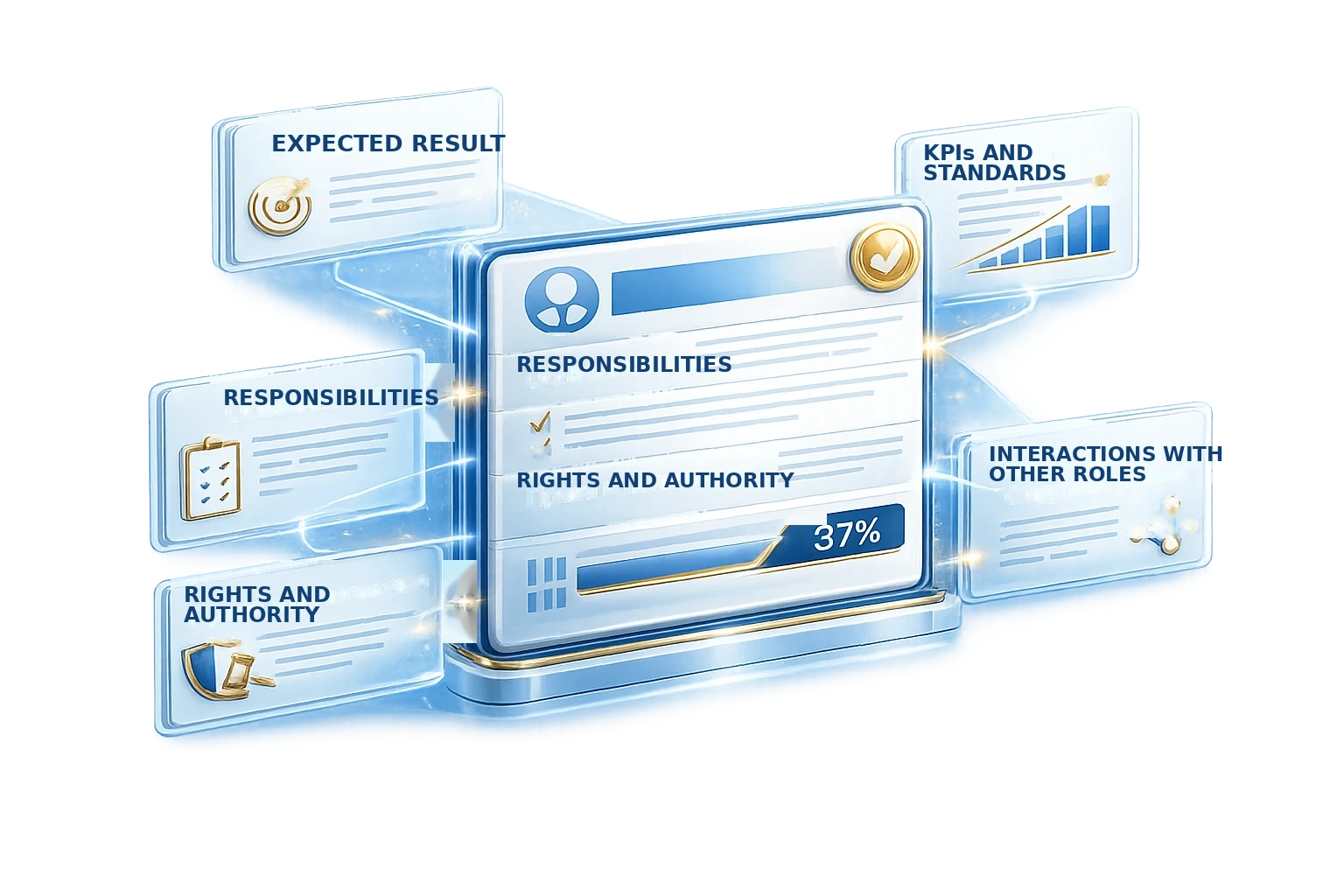
WHAT THE ROLE DOCUMENTATION DEFINESrole → responsibilities → authority → result
01The role’s purpose, place in the structure and reporting relationships
02Required functions, recurring responsibilities and business processes
03Decision authority, approval limits and escalation rules
04Expected output, quality standards, metrics and readiness criteria
NOT A FORMAL DOCUMENT
A practical job description shortens the path to independent performance
A well-designed role document saves managers and teams dozens of training hours. It explains how standard work is performed, what result the role must produce and how the employee and manager will assess completion and quality.
WHEN JOB DESCRIPTIONS DO NOT WORK
Knowledge remains undocumented, and the same work is performed differently
A formal three-page document may satisfy an inspection, but it does not help employees perform work consistently, understand the expected result or prepare for independent responsibility.

Every new employee is trained from scratch
Whenever a new employee joins, experienced colleagues spend hours or days explaining systems, scripts, reports and routine procedures.

The document exists only for compliance
The company has a formal job description, but employees do not use it in daily work and continue to perform the same tasks differently.

Standard tasks are performed differently
Employees use different sequences, reporting formats, tools and quality criteria for the same recurring work.

Managers repeat the same explanations
Instead of managing results, managers repeatedly explain where to find information and how to perform routine tasks.

The expected role deliverable is undefined
The document lists duties but does not state the specific completed result the employee must regularly produce.

Readiness for independent work is not verified
The company has no defined knowledge, practical-skill or quality criteria for authorizing an employee to work independently.
SOLUTION COMPONENTS
What a complete role profile and job description include
We do not stop at a list of duties. We document the role’s expected output, recurring functions, business processes, decision authority, operating standards, performance criteria and knowledge requirements.
Role profile
A concise management model of the role: purpose, place in the structure, reporting line and key operating relationships.
- role in the structure
- manager and key interfaces
- role purpose
Expected role deliverable
The specific completed result the role must regularly produce for the company or the next participant in the process.
- expected output
- deliverable recipient
- completion criteria
Functions and responsibilities
A complete set of required activities, without gaps, duplication or undefined areas of ownership.
- ongoing responsibilities
- periodic activities
- boundaries of responsibility
Business processes
The sequence of key operations, including inputs, steps, outputs, handoffs and interaction with other roles.
- sequence of actions
- handoff points
- exceptions and escalation
Decision authority
The decisions the employee may make independently and the situations that require approval or escalation.
- decision rights
- limits and constraints
- approval and escalation
Operating standards
Requirements for quality, timing, document formats, CRM use, reporting and communication.
- quality requirements
- timing and format
- tools and systems
Performance criteria
Measurable indicators used by the employee and manager to assess execution and the quality of the role’s output.
- role metrics
- target values
- deviation review
Knowledge assessment
Questions and practical assignments that verify understanding and readiness before independent work begins.
- assessment questions
- practical assignments
- approval for independent work
DOCUMENT ARCHITECTURE
Discuss the document structure
The document is built around the role’s output—not a formal list of duties
The role’s place in the organizational structure, expected output, required processes, operating standards, decision authority and performance criteria must form one coherent system.
Place in the management system
Connect the role to the organizational structure, manager, direct reports and collaborating positions.
Expected role deliverable
Define the completed result the business must consistently receive from the role.
Processes and standards
Document key work sequences, quality requirements, tools, templates and handoffs.
Performance and development
Define metrics, knowledge assessment, review frequency and the procedure for keeping the document current.
OPERATIONAL DOCUMENT SET
Documents and tools that define how the role operates
The documentation must be practical for the employee, manager, HR team and internal training function—not simply stored in an archive.

Role charter
Role title, purpose, place in the structure, reporting line and principal operating relationships.
role · structure · relationships
Deliverable map
The role’s expected deliverable, its recipient, and the quality or completion criteria.
deliverable · recipient · criteria
Responsibility map
Required functions, frequency, ownership and expected results of recurring activities.
functions · frequency · ownership
Process descriptions
Key work sequences, inputs, outputs, exceptions and cross-functional handoffs.
processes · handoffs · exceptions
Authority matrix
Independent decisions, approval requirements, limits and escalation procedure.
authority · limits · escalation
Standards and templates
Execution rules, checklists, document formats, CRM requirements and reporting templates.
standards · templates · tools
Performance criteria
Metrics, deadlines, quality requirements and evidence that work has been completed.
metrics · deadlines · quality
Knowledge assessment
Questions and practical assignments used to verify understanding of the role’s operating rules.
questions · practice · readinessA complete working set for each role
We develop the role profile, detailed job description, process descriptions, standards, assessment criteria and knowledge-testing materials as one integrated package.
The format and level of detail depend on the role, process complexity, quality requirements and the company’s training system.
ROLES COVERED
One template does not fit every role
The content and level of detail depend on management responsibility, process complexity, risk and the nature of the expected output.
HOW IT IS USED
One role document connects recruitment, onboarding, daily work and performance assessment
The same source document supports several management processes and reduces the company’s dependence on undocumented knowledge and repeated verbal explanations.
Recruitment
The role profile defines candidate requirements and allows applicants to be assessed against the actual position.
Onboarding
The employee receives the systems, processes, standards, templates and expected deliverables required for the role.
Daily work
The employee follows documented sequences and standards without repeatedly asking the manager how routine work should be performed.
Managerial review
The manager compares actual performance with documented responsibilities, deadlines, quality requirements and expected deliverables.
Training and certification
The job description becomes a structured training program and the basis for assessing knowledge and practical skills.
Process changes
When the operating model changes, responsibilities, standards, metrics and related training materials are updated together.
HOW WE IMPLEMENT
Five steps to effective job descriptions
We first define the role’s place and expected output, then document responsibilities and processes, validate the content in practice and embed it in onboarding, assessment and management.
1
Role assessment
Study the role’s place in the structure, actual responsibilities, interactions and current operating problems.
2
Purpose, output and authority
Define the role’s purpose, expected deliverable, decision authority and performance criteria.
3
Responsibilities and processes
Document required activities, work sequences, standards, templates and handoff points.
4
Validation with employees and managers
Compare the document with actual practice, resolve contradictions and confirm that it is usable.
5
Implementation and assessment
Embed the document in recruitment, onboarding, training, certification and a regular update cycle.
WHAT THE CLIENT RECEIVES
Not a formal document, but an operating system for the role
Role profiles
Role purpose, place in the structure, reporting relationships, key interfaces and expected deliverable.
Detailed job descriptions
Responsibilities, processes, standards, decision authority, tools and output requirements.
Performance criteria
Metrics, deadlines, quality requirements and completion evidence that are clear to both employee and manager.
Knowledge-assessment materials
Questions and practical tasks used to verify understanding and readiness for independent work.
NEXT STEP
Develop practical job descriptions for your company
We will turn the actual work of each role into a clear operating document that supports onboarding, daily execution, management review and employee assessment.
- connect roles to the organizational structure and departmental deliverables;
- document responsibilities, processes, decision authority and performance criteria;
- prepare materials for onboarding, training and knowledge assessment.
Discuss job descriptions
The focus is the employee’s real work, a clearly defined output and practical use of the document in daily management.