








Sales and CRM
Lead handling, CRM discipline, proposal preparation, customer communications, revenue forecasting and decision support for sales reps.
Explore AI for sales →
 Management system25 solutions
 Strategy and development5 solutionsBusiness acceleration and tracking4 solutions
 AI implementation7 solutions
 Business Management SystemFlagship end-to-end program
 Choose a learning programPrograms, formats and pricingSpecialized programsSeven management system areas
We design and implement AI use cases in specific business functions: sales, marketing, finance, HR, logistics, customer service and operations. The focus is measurable impact on revenue, cycle time, inventory, reporting quality and staff workload.
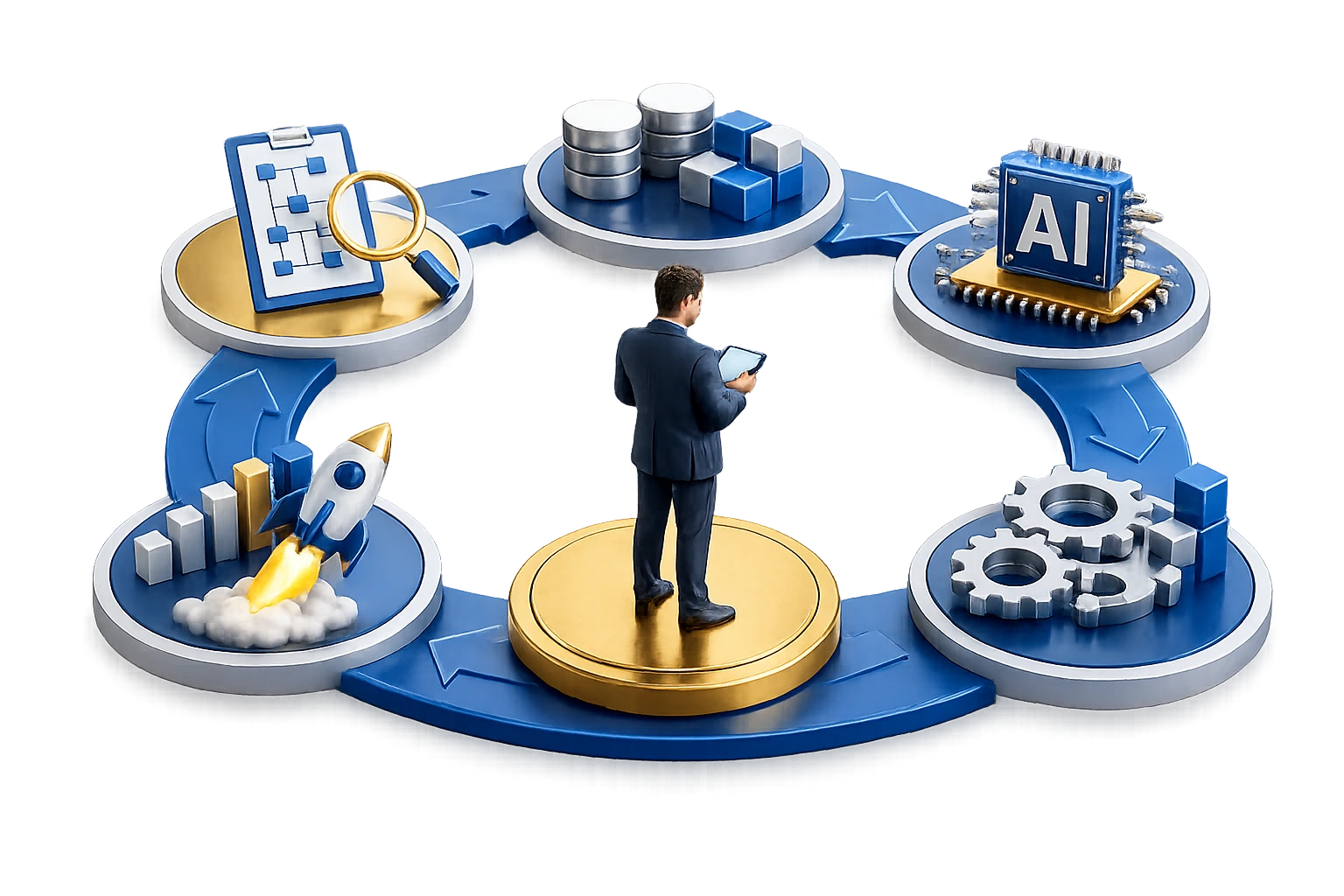
We do not start by choosing a model. We first define the business metric: revenue, margin, CAC, SLA, inventory, reporting cycle time, error rate or staff workload. Then we design the AI use case, build the business case and embed the solution into the operating process.

AI should not automate an “entire department.” It should address a specific recurring operation with defined data, operating rules, an accountable owner and a measurable outcome.
Lead handling, CRM discipline, proposal preparation, customer communications, revenue forecasting and decision support for sales reps.
Explore AI for sales →
Audience segmentation, content production, advertising campaigns, CRM marketing, analytics and hypothesis testing.
Explore AI for marketing →
AI chatbots, knowledge-base search, inquiry classification, agent assistance and quality assurance for customer conversations.
Assess the use case using company data →Management accounting, plan-versus-actual analysis, budgeting, payments, receivables, reporting and forecasting.
Explore AI for finance →
Demand forecasting, inventory planning, procurement, warehousing, routing, delivery management, service levels and variance detection.
Explore AI for logistics →
Shift planning, downtime analysis, maintenance and repair, quality assurance, work instructions and checklists.
Assess the use case using company data →
Recruitment, candidate screening, onboarding, learning, HR service delivery, people analytics and succession planning.
Explore AI for HR →
Contract comparison, identification of risky clauses, document summaries and approval workflows.
Assess the use case using company data →The required data depends on the use case, but a working pilot needs more than a collection of documents. It must link inputs and actions to actual outcomes.
Events, statuses, dates, stage durations and the sequence of actions.
Documents, messages, calls, inquiries, work instructions, knowledge-base content and reference data.
What happened after the action: a sale, payment, error, missed or met deadline, quality result, return or rejection.
Operating procedures, permissions, constraints, exceptions and acceptance criteria.
Customer — deal — payment; product — order — inventory; employee — role — outcome.
Who can access the data, where it is stored, which actions are permitted and how all material activity is logged.
The first use case should not be the most impressive. It should be a process where business value and data quality can be tested quickly and the risk can be contained.
There is a stable flow of similar tasks rather than occasional, one-off expert work.
Before launch, the baseline for time, cost, errors, conversion or another relevant KPI is known.
There is a manager with the authority to change the process and accept the result.
Data sources can be integrated and used lawfully and securely.
An error can be detected and corrected before a critical action.
It is agreed in advance what will happen after a successful pilot and what will happen if the pilot does not meet its criteria.
AI cannot compensate for an undefined process, unreliable data or absent management accountability. In these situations, process redesign or data-preparation work must come first.
There is no stable sequence that can be automated and measured.
The potential savings do not justify configuration, integration and ongoing controls.
Data sources conflict, critical fields are missing or actual outcomes are not recorded.
No one acts on the recommendations or changes how the team works.
The request is framed as “we need AI,” but no business outcome or metric has been defined.
The solution remains separate from CRM, ERP, task workflows, documents and team roles.
Risk is assessed before model selection. Each use case requires defined constraints, roles, activity logging and a clear shutdown procedure.
Transmission of personal, commercial and financial data to external services.
A plausible but incorrect answer, or a conclusion that cannot be traced to a reliable source.
Reproduction of errors, bias or discriminatory patterns contained in historical data.
An automated action without human review, transaction limits or appropriate user authorization.
Employees using unapproved AI services with company data.
Changes in data, the operating process or the model reduce performance after launch.
The business case must be built on the company’s actual baseline. It should include not only labor savings but also the cost of errors, lost opportunities and the total cost of ownership.
Transaction volume × time per transaction × fully loaded hourly cost.
Rework, compensation, penalties and the cost of incorrect decisions.
Unanswered leads, stockouts, delayed payments, downtime or lost margin.
Incremental value is calculated using gross or operating margin, not revenue alone.
Integration, data preparation, model usage, project team and quality assurance.
Licenses, model usage, infrastructure, support, audits and training.
Verified savings + prevented losses + additional margin − implementation and operating costs. Components are calculated separately using company data.
A pilot should test one business hypothesis and conclude with an explicit decision to scale, refine or stop the use case.
We establish the baseline KPI, evaluation sample, test period and minimum acceptable quality threshold.
One operation, one user group or one segment of a process.
The solution uses real data and is embedded into a live workflow.
Critical outputs and actions are reviewed and approved by an authorized employee.
Matched periods or groups are compared, with relevant external changes taken into account.
The measured impact, errors, costs, risks and recommended next step are documented.
The KPI set depends on the business function, but every pilot should measure speed, quality, financial impact, adoption and safety.
Cycle time, response time, document-preparation time or time to decision.
Cost per operation, labor cost, processing cost, cost of errors and infrastructure cost.
Accuracy, completeness, number of corrections and compliance with rules.
Conversion, margin, inventory turnover, SLA, retention or another end-result metric.
Share of tasks processed through the new workflow, active users and reduction in workaround processes.
Critical errors, data leaks, access violations and the share of actions halted by a human reviewer.
The same AI stack creates different value by industry: retail focuses on merchandising and demand, manufacturing on quality and downtime, and services on knowledge, sales and customer support.
Product listings, recommendations, personalization, reviews, demand and customer support.
conversion rate, stockout rate, content-production speedSEO product listings, pricing, advertising, competitors, inventory, reviews and SKU profitability.
faster SKU launches and fewer manual operationsMaintenance and repair, quality control, capacity utilization, shifts, instructions and defect analysis.
downtime, defect rates and operational consistencyInventory, routes, SLAs, warehouses, delay forecasting and dispatching.
service levels, inventory and operating costsSchedules, estimates, documents, procurement, contractors, acceptance certificates and project risks.
budget and schedule adherenceScoring, fraud prevention, underwriting, personalized offers and risk analytics.
decision speed and operating costsResearch, proposals, contracts, reports, knowledge base and material preparation.
more expert time spent on high-value workKnowledge base, standards control, AI audit, support for branch managers and franchisees.
network scalability and management controlWe first define the business objective and metric, then validate the process and data, launch the first use case, integrate it into operating systems and scale it across the team.
We define the business outcome AI must improve: revenue, cycle time, margin, inventory, error rate, SLA or staff workload.
We assess CRM, ERP, 1C, BI, electronic document management, knowledge-base content, user roles and data quality.
We launch the priority use case, connect the required data, configure operating rules and measure the impact.
We embed the solution into systems, communications, reporting, task workflows, team roles and quality-assurance routines.
We formalize KPIs, train users, incorporate the use case into operating procedures and extend AI to other processes.
We will map the relevant processes, select the initial use cases, quantify the business case and prepare a roadmap from the first pilot to scale.